IKS014

IKS014 is currently in Phase 1 dose expansion studies for the treatment of patients with advanced HER2+ solid tumors
Phase 1 dose escalation (n = 71) has completed and Dose Expansion is underway.
IKS014 shows promising anti-cancer activity across a range of HER2+ and HER2-low solid tumors, with a best-in-class tolerability profile
Note: As ‘FS-1502’, the drug is currently in a Phase 3 trial in China, where it is licensed to Fosun Pharma, for the treatment of HER2+ advanced or metastatic breast cancer vs Kadcyla.
IKS014 development status
In Phase 1 dose escalation studies, IKS014 shows promising anti-cancer activity and a favorable tolerability profile
IKS014 is well-tolerated across dose cohorts with anticipated adverse effects being predominantly Grade 1 or 2.
The safety population (June 2025 data cut) included 62 patients who received at least one dose of study drug, with doses ranging from 40 mg/m2 (around 1.0 mg/kg) to 120 mg/m2 (approx. 3.2 mg/kg). The recommended dose for Dose Expansion is 105 mg/m2 (around 2.8 mg/kg).
The safety profile is characterized by anticipated adverse events which included low-grade ocular surface AEs, pneumonitis and hypokalemia.
Ocular events were low-grade, (G1 or G2), with only one patient (who did not receive any ocular prophylaxis) experiencing a G3 event at the highest dose tested. No G3 events were observed for the 2.8 mg/kg dose. Ocular toxicities were predominantly low-grade dry eye and, unlike other MMAF-directed ADCs, were not associated with the cornea.
In addition, and distinct from other GER2-directed ADCs, no ≥Gr 3 pneumonitis events were reported; at 105 mg/m2 there were two events (one G1 event and 1 G2 event) across 10 patients.
Hypokalemia was predominantly G1/ G2 and addressed with oral K+ supplementation. GI toxicities (nausea, vomiting and diarrhea) were low in frequency and grade across dose cohorts. In the 105 mg/m2 group, only one patient experienced vomiting (G1), whilst no patients suffered diarrhea.
IKS014 is also associated with substantially lower frequency and grade of GI toxicities and fatigue than other HER2-directed ADCs including Kadcyla and Enhertu.
Anti-tumor activity was observed across dose levels and tumor indications
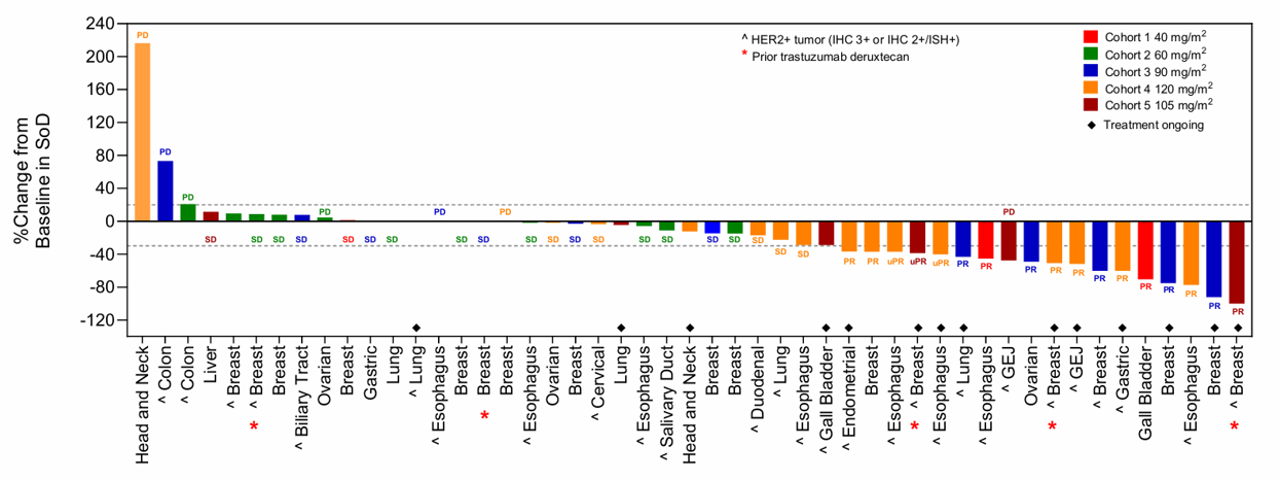
Amongst 11 patients with advanced breast cancer treated at doses ≥ 90 mg/m2, ORR was 64%. Responses were seen in all 4 patients with HER2+ disease, including 3 patients who had previously received Enhertu
Among 10 patients with pre-treated HER2+ esophageal cancer, 5 achieved a response including complete regression in one patient with non-measurable disease
PRs were observed in patients with gall bladder, ovarian, endometrial, gastric and GEJ cancers, as well as NSCLC.
At the data cut-off, 55 patients were evaluable for efficacy according to RECIST. The median duration of follow-up was approximately 6.6 months.
Encouraging anti-tumor activity was was seen across all dose levels. Partial responses (PRs) and unconfirmed PRs (uPR) were observed in a variety of tumor indications including breast, lung, esophageal, ovarian, gallbladder and GEJ cancers in both HER2+ and HER2-low tumors.
Responses were noted in 18 patients: 13 PR, 4 uPR, 1 CR (patient with non-measurable disease). Durable responses were noted across tumor indications and dose levels. The overall response rate for relevant cohorts, (doses of ≥ 90mg/m2) was comparable with Enhertu DESTINY-PanTumor-02.
IKS014 shows good efficacy across a range of tumors and doses
Phase 1 Part I enrolled patients with a wide range of tumors and a mix of HER2+ and HER2-low expression.
21 of the 49 patients referenced in the waterfall plot had HER2-low disease. PRs were observed in patients with breast (3), ovarian (1) and gall bladder (1) cancers.
2 PRs were seen in the lowest dose cohort of 40 mg/m2 (gall bladder and esophageal cancers)
Clinical trial overview
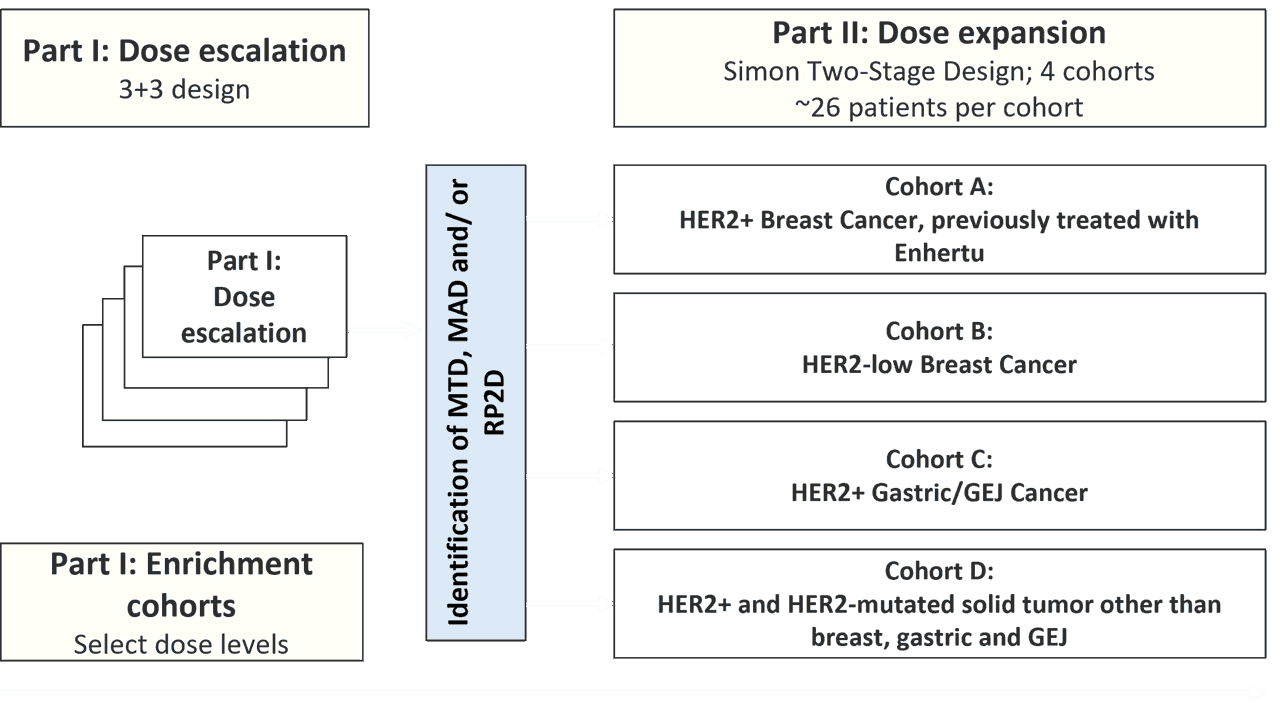
Part I dose escalation has been completed and was a 3+3 design study, with a primary objective of safety (MTD). There are 5 dose cohorts in this study, with doses ranging from 40 mg/m2 to 120 mg/m2 (approx. 1.0 to 3.2 mg/kg). The Recommended Dose for Part II (Dose Expansion) is 105 mg/m2 (around 2.8 mg/kg)
Part II is a dose expansion study in specified indications, with a primary objective of Objective Response Rate (ORR)
HER2 expression is defined as IHC3+, IHC2+/FISH+ or FISH+ and HER2-low expression is defined as IHC1+ or IHC2+/FISH-
Patients will be recruited across sites in Australia, the US, Singapore and New Zealand
Site locations
Australia
Australia Linear Clinical Research, 1 Hospital Avenue, B-Block, 1st Floor, Nedlands WA 6009, Australia
Peninsula & South Eastern Haematology and Oncology Group (PSEHOG), South Building, 5 Susono Way, Frankston VIC 3199
Frankston Hospital, 2 Hastings Rd, Frankston VIC 3199, Australia
Concord Repatriation General Hospital, Hospital Rd, Concord NSW 2139
Westmead Breast Cancer Institute, Block F/189 Cnr Hawkesbury & Darcy Rd, Westmead NSW 2145
Macquarie University Hospital, Sydney NSW
Singapore
National Cancer Center (NCCS), 30 Hospital Boulevard, Singapore
Tan Tock Seng Hospital (TTSH), Novena 308433
New Zealand
Auckland City Hospital, 2 Park Road, Auckland 1023
US
Hoag Memorial, Newport Beach, 1 Hoag Dr Bldg, 41 3rd floor Ste 302, CA 92663
Dana Farber Cancer Institute, Mayer Building, 440 Brookline Ave., Boston, MA 02215
Tennessee Oncology

Differentiation by design
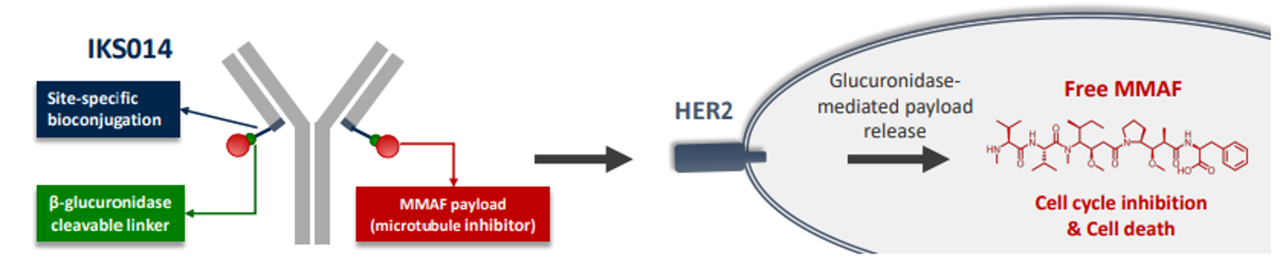
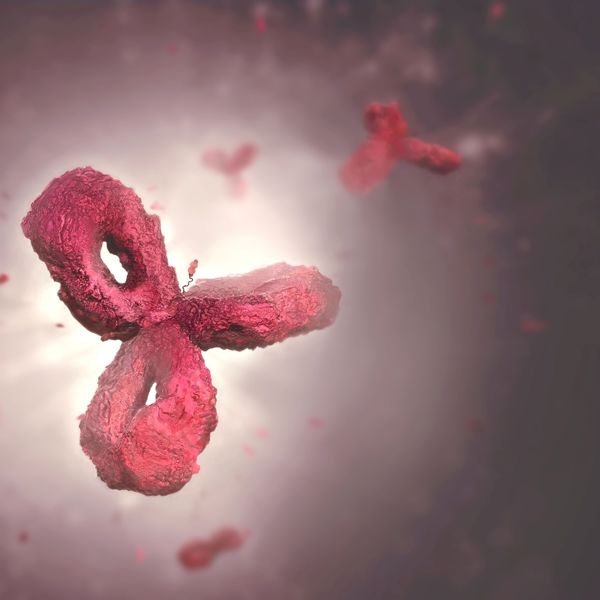
IKS014 is comprised of an anti-HER2 antibody, engineered for site-specific conjugation of an MMAF payload.
The choice of MMAF enables use in patients who have previously received Enhertu and/ or Kadcyla.
A beta-glucuronide liker is used for tumor-selective enzymatic payload release, enabling precision targeting to cancer cells and a reduction in payload-associated toxicities.
Tumor-selective payload activation drives a differentiated clinical profile
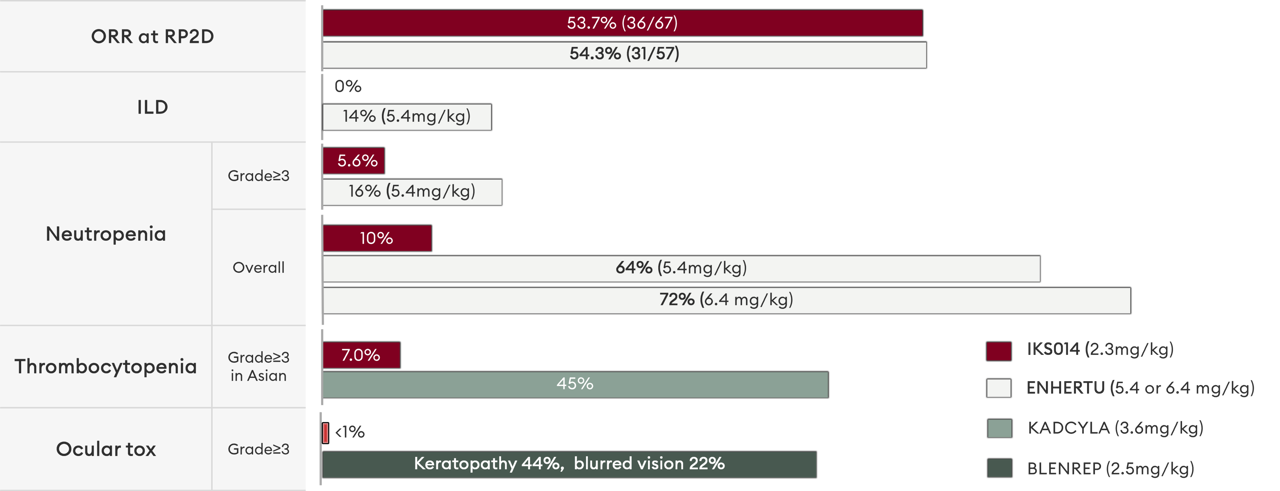
Phase 1 clinical studies have confirmed an improved safety profile compared with other HER2-directed ADCs, including Enhertu and Kadcyla.
Compared with Enhertu and Kadcyla, there is significantly less neutropenia and thrombocytopenia and, importantly, a lack of dose-limiting ILD or respiratory disorders.
Also, unlike Blenrep - the on-market benchmark MMAF-containing ADC, IKS014 is not associated with dose-limiting corneal toxicity or loss of visual acuity. Whereas Blenrep is associated with serious events in 50-63% of patients, with ≥G3 corneal exam findings of >70%, keratopathies in 44% of patients and discontinuation in 1 in 8 patients. IKS014 is only associated with low-grade events such as dry eye and keratitis. The lack of high-grade corneal toxicities is a clear consequence of the glucuronide-driven tumor-selective payload release mechanism.
Additionally, IKS014 has a significantly lower prevalence and grade of GI toxicities such as nausea, vomiting and diarrhea, and fatigue compared with Enhertu and Kadcyla..
This enhanced safety profile does not come at the expense of efficacy - at the median follow-up of 5.2 months, FS-1502 showed a similar ORR in this patient population to Enhertu at a similar data cut-off point.
The profile safety profile observed with IKS014 is consistent with that seen with FS-1502 in Fosun's Phase 1 study, (data shown below).
Iksuda has Best in class TI for HER2-directed therapies
Preclinical data has shown that IKS014 is associated with a significantly superior TI over Kadcyla and Enhertu.
Efficacy was similar or better than Enhertu and superior to Kadcyla in xenograft models for breast and gastric with moderate-to-high HER2 expression, whilst GLP toxicology confirmed a differentiated toxicity profile and an HNSTD of >12-fold the minimal effective dose (MED).
Preclinically, the advanced ADC design of IKS014 was shown to avoid dose-limiting ocular toxicities that are associated with MMAF-based ADCs, and respiratory, blood & lymphatic toxicities that are dose-limiting for other anti-HER2 ADCs including Enhertu.
| KadCYLA (T-DM1) | ENHERTU | XMT-1522 | IKS014 | |
| Company | Genetech/ Roche | Daiichi Sankyo/ AstraZeneca | Mersana/ Takeda | Iksuda |
| Payload (DAR) |
DM1 |
DXd (7.7) |
Auristatin D (15) |
MMAF (2) |
| MED (JIMT-1) | >20mg/kg | >10mg/kg | 1mg/kg | 1mg/kg |
| HNSTD | 30mg/kg | 30mg/kg | 2.5mg/kg | 12mg/kg |
| TI | <1.5 | <3 | 2.5 | 12 |
Downloads


Iksuda receives US FDA IND clearance for IKS04
CA242-directed ADC approved for assessment in Phase 1 trials in patients with GI cancers The ‘IKS04 Regimen’, is an innovative dosing approach for an ADC which is employed to overcome the challenge of solid tumour penetration for high-potency payloads

Iksuda to present preliminary analysis of oesophageal cancer data from Phase 1 study of IKS014 at ASCO Gastrointestinal Cancer Symposium
Encouraging anti-tumour activity seen across all dose levels and in various tumour indications Clinical benefit rate of 80% for 10 patients with HER2+ oesophageal cancer who had received prior therapy that included a trastuzumab component in at least one prior treatment

WADC Award November 2025
World ADC is considered the premier global conference for end-to-end ADC innovation and success, and is the world's largest, definitive and longest standing ADC forum. IKS014 was selected based on excellent data from the ongoing Phase 1 clinical trial assessing safety and efficacy in HER2+ and HER2-low solid tumors.
Iksuda presents encouraging IKS014 Phase 1 data at ESMO
New safety, efficacy and pharmacokinetic results presented from dose escalation portion of the study Anti-tumour activity observed across all dose levels and in various tumour indications
Iksuda to present IKS014 Phase 1 data at ESMO
Newcastle, UK, 14 October 2025: Iksuda Therapeutics (Iksuda), the developer of class-leading antibody drug conjugates (ADCs), will present new data from its Phase 1 study of IKS014, a human epidermal growth factor receptor 2 (HER2) ADC, in patients with advanced HER2+ solid tumours, at the European Society for Medical Oncology (ESMO) Congress in Berlin, Germany (17-21 October).

Iksuda share paper via AACR
Iksuda Therapeutics are pleased to share that our paper "IKS04, a CanAg-Targeting Antibody-Drug Conjugate with Pyrrolobenzodiazepine, Shows Enhanced Efficacy with Unconjugated Antibody Coadministration in Animal Models" has been published via AACR Journals.
Iksuda Therapeutics receives FDA IND clearance for IKS014
FDA decision will enable Iksuda to expand its ongoing clinical trial in the US, Australia and Singapore. Preliminary data from an ongoing dose-escalation study of IKS014 has shown meaningful clinical activity across multiple tumour types
Iksuda Therapeutics announces first patient successfully dosed in phase 1 trial evaluating IKS03 in advanced B cell non-Hodgkin lymphomas
First-in-human trial is designed to determine recommended dose of IKS03, a CD19-directed antibody drug conjugate, for the subsequent dose-expansion. IKS03 is Iksuda’s second asset to begin clinical testing.
Iksuda to present growing ADC pipeline at AACR
Introduces the ProAlk payload series to address the growing challenge of ADC sequencing
Iksuda abstracts at AACR 2025
Iksuda’s abstracts have been scheduled for presentation in a Poster Session at the AACR Annual Meeting 2025 in Chicago, on Monday April 28 and have been published to the AACR Online Program Planner.

First patient dosed in Phase 1 Trial
Iksuda announces first patient dosed in Phase 1 trial of IKS014
Iksuda deepens clinical pipeline
Iksuda Therapeutics deepens clinical pipeline through licensing agreement for Her2 antibody drug conjugate programme from LegoChem Biosciences
LegoChem Biosciences and Iksuda Therapeutics expand License Agreement for development of antibody-drug conjugates
Expanded agreement grants Iksuda access to Legochem Biosciences’ next generation ADC platform for up to six targets
Iksuda Therapeutics closes $47 million financing round
• Funding to accelerate clinical progression of Iksuda’s pipeline of new generation of antibody drug conjugates, targeting tumours with high unmet need • Investment round led by Korean-based Mirae Asset Capital and Celltrion
Iksuda enters license agreement with University of Goettingen
Iksuda Therapeutics enters license agreement with University of Goettingen to develop a new generation of antibody drug conjugates
Licensing agreement with LegoChem Biosciences
LegoChem Biosciences and Iksuda enter Licensing Agreement for Antibody Drug Conjugate program
LCB and Iksuda Enter into a Multi-Target Research Collaboration
LegoChem Biosciences and Iksuda Enter into a Multi-Target Research Collaboration and License Agreement for the Development of Antibody-Drug Conjugates
Forging stable relationships for Antibody-Drug Conjugates
DCs are a class of biopharmaceuticals that target cancer cells while leaving healthy cells alone.
Iksuda Therapeutics presents first data on lead antibody drug conjugate, demonstrating effective tumour regression
IKS01 shows marked anti-tumour efficacy in pre-clinical models of ovarian and lung cancer
Iksuda Therapeutics and Femtogenix sign license agreement
Agreement gives Iksuda access to Femtogenix’s therapeutic payloads to advance lead ADC for difficult-to-treat solid tumours
Iksuda Therapeutics move into The Biosphere and open a US based office
We’re excited to announce our move into a brand new, purpose built facility, The Biosphere at Newcastle Helix.
Glythera Announces Corporate Name Change and Rebranding to Iksuda Therapeutics
New identity reflects transition in corporate focus, from technology licensing to drug development, for previously untreatable cancers
Glythera appoints Professor Kerry Chester to SAB
Appointment supports the development of the Company’s pipeline
Glythera appoints Chief Scientific Officer and strengthens SAB
Dr Robert Lutz appointed as CSO to support development of next-generation PermaLink® Antibody Drug Conjugates
Positive Outcome of Proof-of-Concept Study with Glythera and Follow on Drug Development Partnership
Successful proof-of-concept study leads to Affimer drug conjugate development partnership
Glythera licenses novel payload class from Cancer Research UK for the development of next-generation antibody drug conjugates
Glythera gains exclusive access to Cancer Research UK’s novel CDK11 inhibitor programme for the development of ADCs conjugated using its highly stable conjugation platform, PermaLink®
Glythera and IONTAS enter into license agreement for the development of multiple antibodies for next-generation Antibody Drug Conjugates
IONTAS will provide Glythera with antibodies from its fully human antibody libraries
Glythera appoints Dr Mike Owen as non-executive director
Glythera Limited (‘Glythera’), the next generation antibody drug conjugate (‘ADC’) development company, is pleased to announce the appointment of Dr Mike Owen to the Board as a non-executive director with immediate effect.
Glythera launches UK government funded project to develop safer and more efficacious ADCs for the treatment of difficult-to-treat tumours
Development of proprietary next generation ADC portfolio
Glythera demonstrates improved activity and safety of PermaLink®-based ADC
Appoints Scientific Advisory Board
Glythera wins prestigious biomedical award
2014 Biomedical Awards, hosted by Bionow at the BALTIC Centre
Avacta and Glythera announce collaboration to develop novel, potentially highly potent, drug class
The collaboration will evaluate the use of Avacta’s Affimer technology in combination with Glythera’s PermaLink conjugation chemistry
Glythera-led consortium wins Industrial Biotechnology Catalyst funding
£248,000 to develop high-throughput glycosylation assay
Glythera unveils PermaLink®, its proprietary ADC cysteine linker technology
A next generation linker displaying very high stability with improved selectivity and specificity
Glythera’s Environmental Policy
We are delighted to announce Glythera’s environmental policy.
Biomedical start-ups benefit from dose of northern exposure
While City investors and Westminister politicians have been weighing a Pfizer bid for AstraZeneca, a very different attempt to capitalise on UK scientific research has launched in the north of England.
Glythera STEM Ambassadors
Glythera’s CEO David Simpson and Glythera’s Technical Director Jenny Thirlway are fully approved STEM Ambassadors!
Newcastle drugs company Glythera Ltd forges new partnership with BioOutsource Ltd
Newcastle-based Glythera Ltd, a biotechnology company specialising in the development of the next generation of biological therapeutics that are used in treatments for diseases like cancer, has joined up with Glasgow firm BioOutsource Ltd. www.thejournal.co.uk
Glythera shortlisted for 2014 Biomedical Awards
Sixteen companies have been shortlisted within five categories for the 2014 Biomedical Awards Ceremony. The event will celebrate the diversity of the companies within the North of England’s biomedical sector, and the strength and depth of the cluster.
Glythera makes Significant Appointments to Support Company Expansion
Glythera Set to Benefit From Nigel Burns and Ian Evetts Strategic Biotherapeutics Experience
Glythera is now working with Newcastle Science City and the Environmental Academy to reduce its Environmental Impact
We are pleased to announce that Glythera is now working with Newcastle Science City and the Environmental Academy to reduce its Environmental Impact!
BioOutsource expands ADC characterisation capabilities
A global leader in ADC characterisation, BioOutsource, partners with Glythera.
North East Based Biotechnology Firm Receives £700k Funding Boost
Investment will progress the development of a new generation of biological therapeutics through advanced glycosylation technologies.
Glythera relocates to North East as part of £2M funding round
Glythera, an emerging biopharmaceutical company specialising in protein/peptide functionalisation and glycosylation, has secured a fundraising round totalling £2M with IP Group, which will be tranched over the next three years.
Achieves key technical and commercial milestones
Second tranche of seed investment triggered
Glythera and the FDA enter into vaccine research collaboration agreement
The FDA is to assess the feasibility of Glythera technology in developing antigenic glycoproteins as synthetic conjugate vaccines.
Keep informed
Sign up for our latest programme news and insights