
Tumor-selective Payload Activation

All Iksuda’s ADCs benefit from tumor-selective activation and release of payload for added safety.
Iksuda's prodrug approach is driven by the use of β-glucuronide (BG) linkers and triggers, ensuring that the payload is only released in cancer cells, thus avoiding the risk of on-target, off-site toxicity.
β-glucuronidase is overexpressed in many cancers and is isolated to cancer cell lysosomes. It is active at acidic pH, has low expression in healthy tissues and is not found in circulation. Traceless chemistry allows use of BG linker/ triggers with multiple payload classes.
In our ADC pipeline, BG linkers are used with MMAF, PBDs and our new payload class of protein alkylators, ‘ProAlk’.
The BG-driven prodrug approach is now clinically validated
Through the ongoing clinical study of IKS014, the BG linker approach has been shown to drive enhanced TI, with potent ADC activity allayed to favorable tolerability profiles compared with competitor programs.
In IKS014-01 (dose escalation), IKS014 shows good anti-cancer activity in heavily pre-treated patients with a range of HER2+ and HER2-associated solid tumors, including those of the breast and upper respiratory tract, with objective response rates similar to those seen in the Enhertu DESTINY-PanTumor02 trial.
IKS014 is also associated with an improved safety profile over other HER2-directed therapies: it is not associated with dose-limiting respiratory toxicities, neutropenia or ocular toxicity and there is a notable absence in other events frequently seen in HER2-targeting therapies such as nausea, vomiting and severe fatigue.
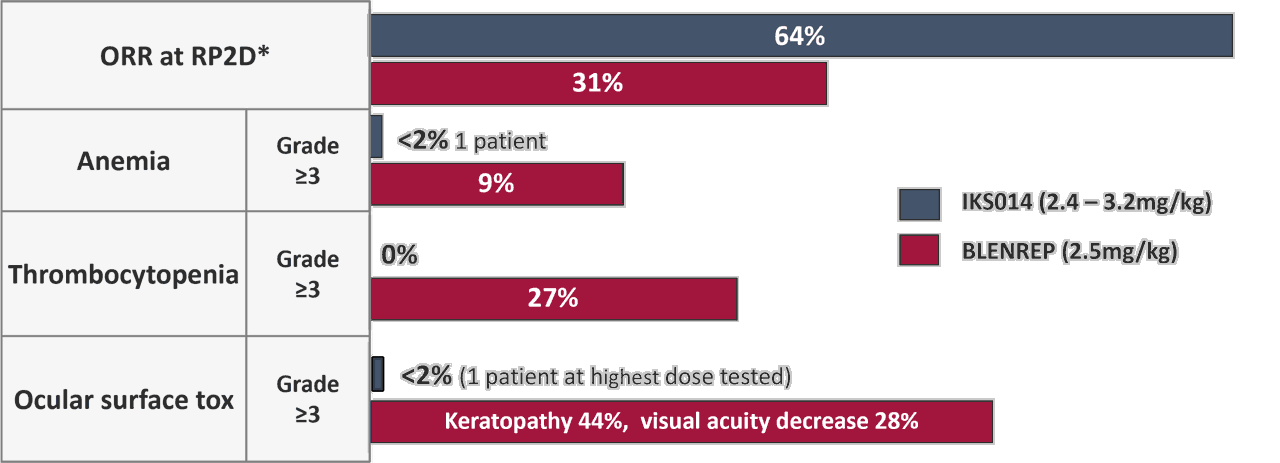
The lack of high-grade ocular toxicities is a clear measure of the benefit of glucuronide-driven tumor-selective payload release. The clinical benchmark for MMAF-based ADCs is Blenrep (belantamab mafodotin), which incorporates a traditional non-cleavable linker. Blenrep is associated with significant ocular toxicity associated with changes in the corneal epithelium, including severe visual impairment, corneal toxicities, high grade keratopathy, eye pain and photophobia. High-grade (G3 and G4) corneal abnormalities are seen in >75% of patients, and keratopathy in 44%.
Conversely, IKS014 is associated with significantly reduced ocular toxicity, predominantly manifesting as low-grade dry eye.
IKS014, an anti-HER2-ADC with a glucuronide linker MMAF design that drives a differentiated clinical toxicity profile compared with mc-MMAF ADCs
Blenrep contains a traditional non-cleavable linker (mc-MMAF), and is associated with special warnings for ocular events, especially those related to the cornea.
IKS014, at the dose recommended for dose expansion studies, is associated with significantly lower grade ocular events, with no high-grade (G3, G4) events and no corneal toxicities.
Blenrep is also associated with warnings for thrombocytopenia, pneumonitis and infusion-related reactions, whereas IKS014 shows a markedly improved profile.
Tumor-selective activation & release of the right payload drives a differentiated clinical profile
The selection of a tubulin binder MoA for breast cancer is a logical choice, and MMAF allows the possibility of successful sequencing in patients who have previously received Enhertu and/ or Kadcyla.
However, MMAF-based ADCs such as Blenrep are associated with dose limiting ocular toxicity. A handful of MMAF-ADCs are currently in preclinical or early clinical study but, with designs that incorporate traditional linker formats, they are also associated with corneal toxicities such as high-grade corneal epitheliopathy.
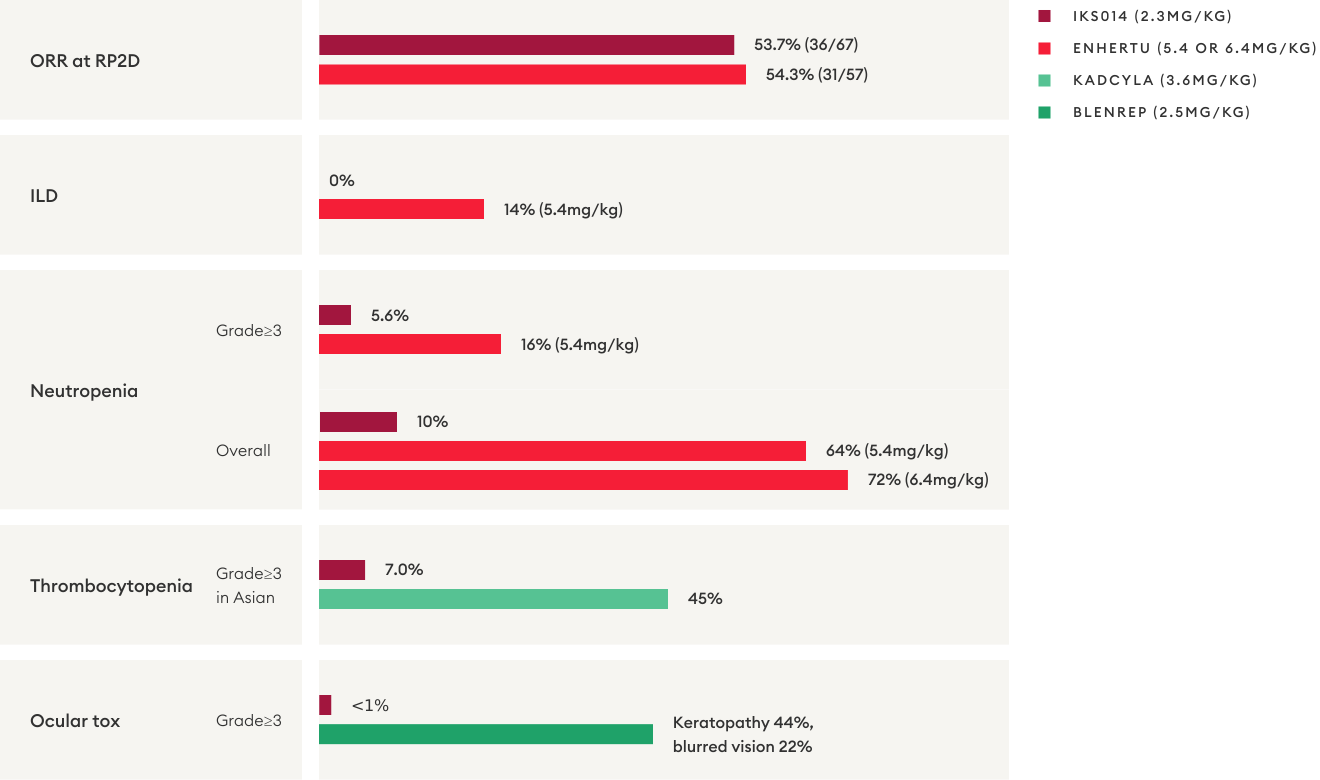
Compared with Blenrep, IKS014 shows a marked reduction in dose-related ocular toxicities and an absence of those associated with the cornea, demonstrating strong validation of the benefit of tumor-selective activation. Blenrep is also associated with dose-limiting thrombocytopenia, anemia, fatigue and GI toxicities, whilst IKS014 is absent of these high-grade events.
Compared with Enhertu, IKS014 is associated with lower pulmonary toxicities, neutropenia and GI toxicities and, compared with Kadcyla, there is a marked reduction in thrombocytopenia.
Data presented at SABCS 2023: data cut-off December 2022 after a median follow up of 5.2 months.
Tumor-selective payload release for enhanced precision targeting
The BG linker/ trigger format leads to superior efficacy and wider tolerability than clinical benchmarks
For example, Iksuda’s CD19-directed ADC IKS03 demonstrates an order of magnitude improved differential in tumor vs normal cell killing compared with the clinical benchmark SGN19B.
SGN19B induces total B-cell depletion at doses below its effective dose whereas IKS03 does not induce complete B-cell depletion at doses far in excess of its effective dose. This supports the hypothesis of differentiated tumor cell activation of linker/ payload due to the difference in glucuronidase activity. 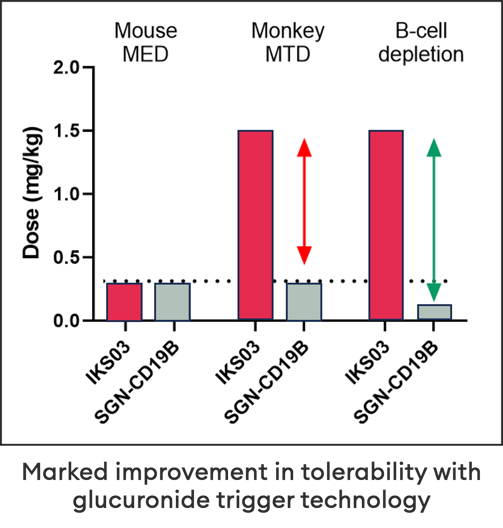
Expanding clinical utility of tumor-selective payload activation

Contact us about partnerships for ADC design & development
